There are various occupational hazards in crafts. Humidity – indeed moisture in general. Sticky tape. Inky fingerprints. Cats – more specifically their paws. Going down a rabbit hole of ASMR videos of EVA ‘peels’ is definitely not a phrase I ever thought I would type but is another subject for another day.
No, today was about trying to reduce the dreaded ‘stash’. Anyone who makes prints or things with prints in any medium or technique will recognise the problem – a box/ drawer / cupboard / house with an ever expanding collection of materials you’ve bought / made / thrifted / stolen from skips / bought in ill-advised sales / bought in absolutely intentional and totally worth it sales, or even inherited (yes, it’s a genetic condition). The stash. Bookbinders additionally end up with collections of moquettes, reference structures, handouts, and failed experiments that can’t possibly go in the bin (snarkier bookbinders might call these things book arts).
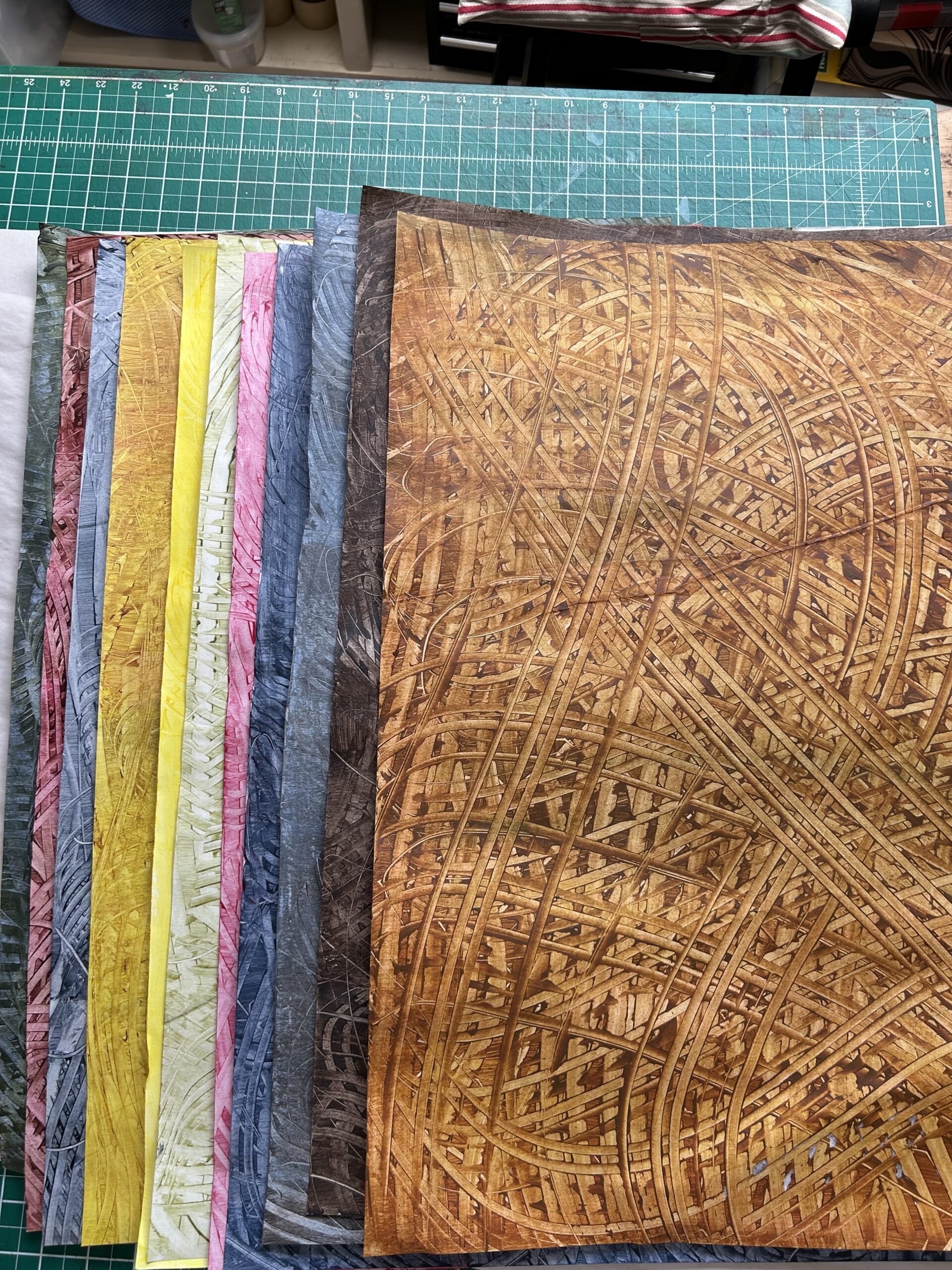
With this in mind I give you exhibit A – roughly a third of the paste papers I made last week as a by-product of running a workshop on, um, making paste papers. Having been (usefully) forced to restrict my palette and tool choices I decided to lean in to the constraints imposed on my own students to practice repetition of technique to create themed sets of papers – similar in principle to using different marbling patterns.
The paste papers are A2, so I have quite a bit of flexibility with what to could be made with them. One small concern – as ever – is ending up making things that I either can’t sell or can’t give away. This is the main reason why I don’t simply make multiples of the same thing. So I am currently thinking of adding a new constraint – making as many different things from a single sheet to make a ‘collection’ of themed objects.
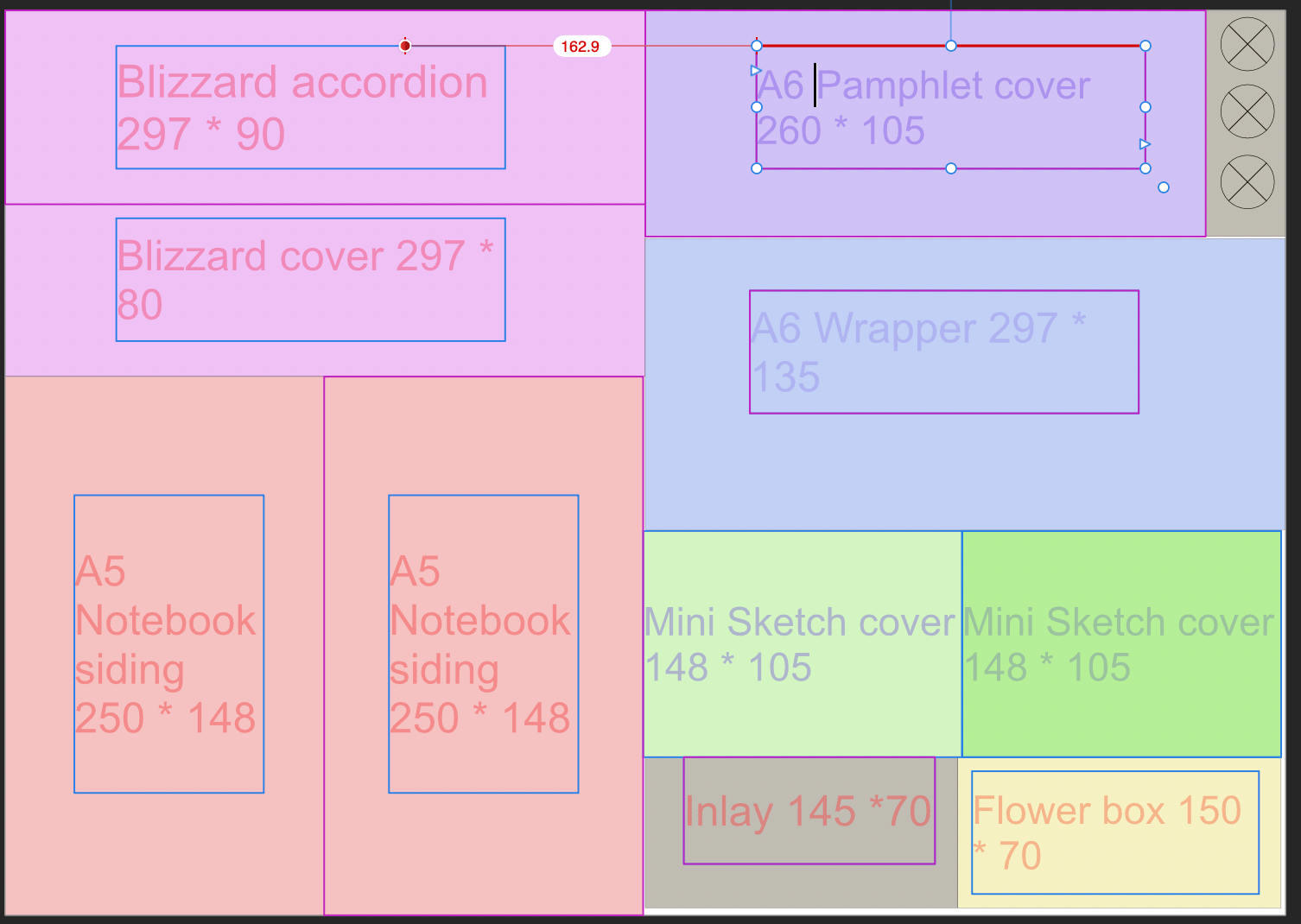
Most of these structures are also part of my workshop repertoire, which is not exactly a coincidence. So far the most appealing long division of the sheet would create material for the following:
- A5 hardback notebooks (‘sidings’ will cover ~80% of the boards);
- Two A6 pamphlet covers (one ‘simple’, one with spine and pocket);
- A crown book with a wrapper;
- ~A8 mini sketchbook covers (people seem to like these as stocking fillers);
- An origami box;
- An inlay – possibly for a linen A5 notebook, but possibly for an artist book (variations on my Aurora book, probably);
- I have a small square left over – this will get used for collage pieces.
Which by my reckoning is up to seven items from a single sheet. And if I particularly like the results / get bored with the long division I could simply stick to two A5 notebooks and up to two of the smaller formats.
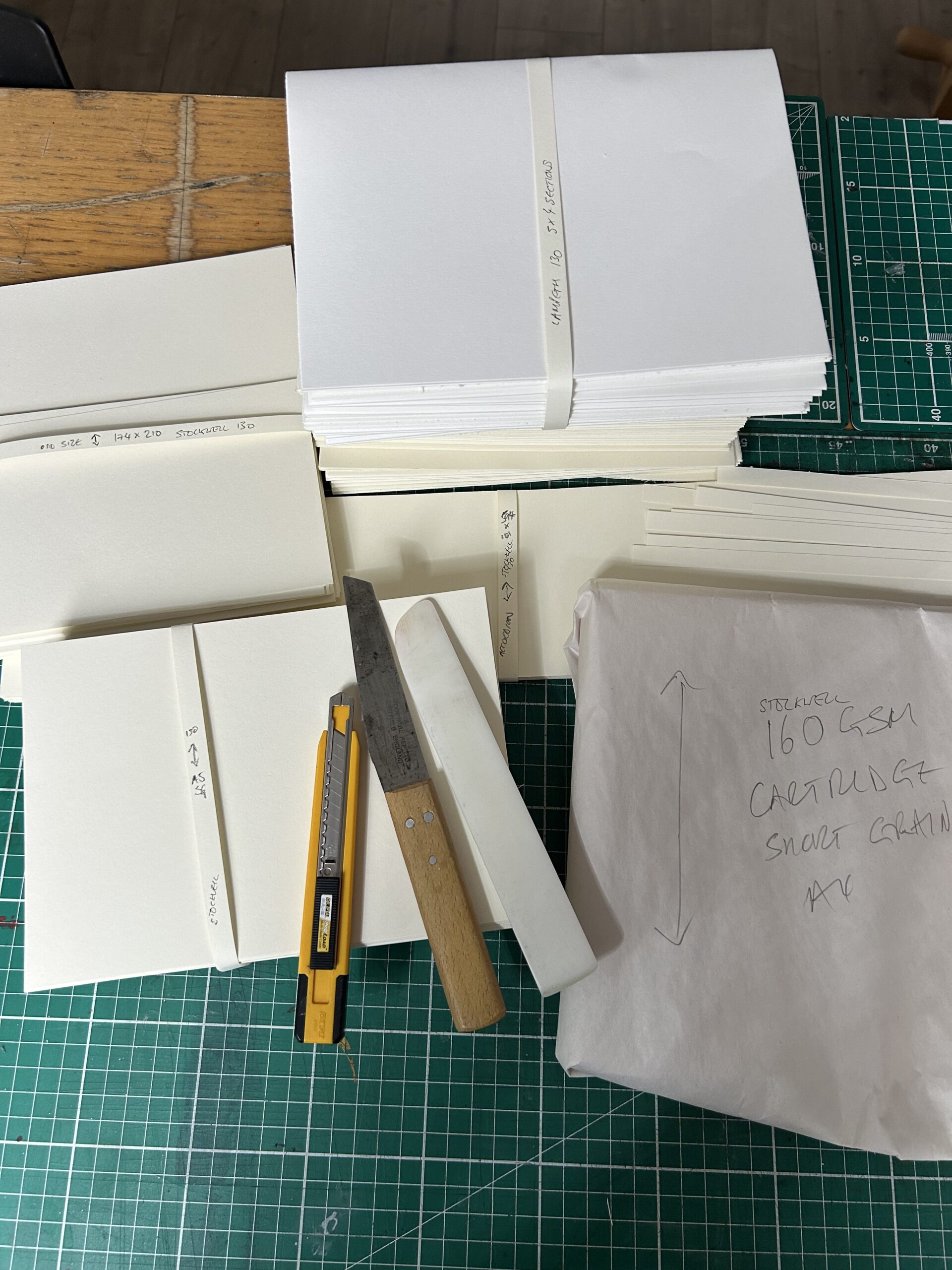
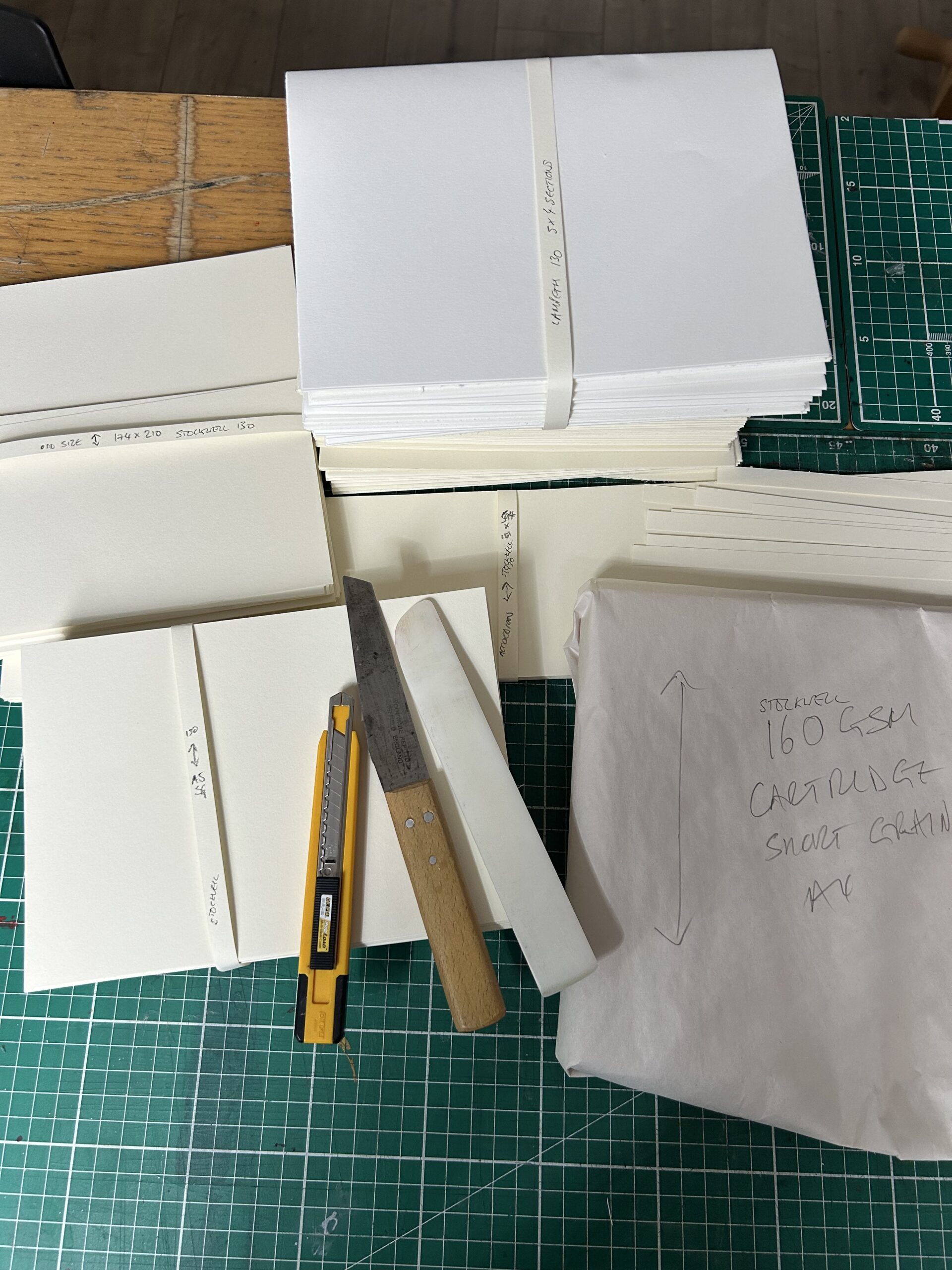
Of course this only covers the covers, so to speak. I also need to make the text blocks and/or pages. So I spent a few hours doing the slow and mildly therapeutic task of cutting down and folding A1 sheets of paper into the required sizes and grain directions. I think I went through 60 sheets in total – 20 using the pattern on the left (ten sheets of A5 short grain for A6 pamphlets, the inlay book and possibly the accordions). I used 30 sheets with the pattern on the right is the simplest way to make sections of A4 short grain (each sheet makes two sections of 16 pages) for the A5 notebooks. I also took the opportunity to cut some more paper for the next paste paper workshop – might as well make the most of getting in a folding and swishing rhythm make the most of it. Once cut and folded, it’s quite surprising how small a pile it actually makes….


Anyway. I appreciate dear reader that this is not the most interesting of topics, but we are increasingly told to document our process. So here we are, you and I, locked in a metaphorical dance over literally blank pieces of paper.
But the first steps towards batch production are complete – the process of long division will need to continue with greyboard shortly, before I spend hours agonising over the choice of colour for the respective endpapers (and ribbons, headbands etc.,).
Tangent – what makes the choosing of colours more annoying is that it’s probably a waste of Canson Mi-Tientes paper. I also find it particularly unforgiving of minor imperfections. I should probably switch to simply using the heavier weight cartridge paper.
But I digress – the long division of time if you will. And time, right now, to post this and carry on.
Leave a Reply