Blog

  • A collagerie

    A collagerie

    Collage of collages
    A collagerie of collages? Of oddities?

    This week’s MQ Art Club was one of my favourite sessions with this particular group. I’ll describe what I did later on in the blog post, but as I’m in the process of working out what went well and what went less well I’lll write a bit about the general process to begin with.

    Underestimating and overestimating

    This group are younger than previous groups I’ve run, and I’ve faced a few challenges:

    • Are the children capable of the tasks I have prepared? This is as much about social skills as it is about their actual skill with a Sharpie or a paintbrush.
    • Are the children interested in the tasks I have prepared? I spent a considerable amount of time and effort this term in preparing an over-arching narrative for the sessions – a ‘season arc’ if you will, and this hasn’t landed in the way I’d hoped. This partly relates to the previous point about capabilities – the degree of role-playing and world building with relative strangers has been a constant challenge.
    • Do I have the skills to wrangle this particular group? The mix of age groups is not really the issue, as the different year groups largely ignore each other. But what is a definite issue is that I took for granted that I could ‘manage’ a group of 8 year-olds. And while there are some ‘typical’ behaviours, they are very much individuals, with individual needs and interests, even if only for 90 minutes a week. My admiration for school teachers goes up week by week. I have it relatively easy – a small group for 90 minutes once a week.

    Arguably however, the biggest challenge has been my inexperience. For the vast majority of the sessions I have simply never delivered that specific session before, let alone that session in that context. In particular, the context of boredom, or rudeness, or kids simply having had enough of being told what to do on that particular day – one particularly difficult session I only realised as we were packing up that they hadn’t left the building all day as it had rained all day. I needed a physical component that day.

    On plans surviving contact with the enemy children

    I enjoy making the session plans, and while the kids may not always realise or appreciate the effort, I have usually spent hours researching and planning any given session. What this research, and reading around, and even occasionally simply copying other teaching resources can’t prepare you for is the group context. It’s a natural tendency I think to explain too much (verbally) and focus on details that they simply don’t care about.

    This was much less of an issue when the sessions were about collaborative art on a shared canvas – sessions could be much looser and dynamic. But partly because they would go off-script themselves, and partly because this particular set of individuals aren’t equally confident in sharing ideas orally, I abandoned the shared canvas in favour of the shared story / season arc. The unforeseen consequence of switching to more of a ‘product’ approach is that without very clear models/references, some of the group take a very long time to activate. And the provision of references in themselves creates a tension for the more creative folk who then essentially look to ‘take me on’ – either by ignoring the brief or disrupting others. So in general it often feels very disjointed, with the emphasis much more on individual performance, which in principle was what I was hoping to avoid.

    But – first and foremost this is kids-first, so it’s largely a matter of amplifying some aspects and then encouraging the process and effort whenever possible. I think I’m getting a little better at this. I don’t have as much control as my ego wants, and I miss the elaborate group stories, but the children are – I think – a little more engaged than they were. And it’s more fun for everyone as a result.

    On to this week’s session….

    An assortment of oddments and odd minds

    Each child got a stencil, a template and an assortment of marbled and paste papers

    The session itself was to take place in Patchwork Hospital on Mystery Island. (I’ll write more about Mystery Island another time) The narrative setup was that their characters had been given something to drink that had brought them out in … patches. And they were to create pictures of what that looked like. Although of course this is my post-session rationalisation of what I thought I told them, whereas by withholding the idea of the stencils and the templates until the second half some struggled to engage with the notion of ‘patchwork’ or ‘fill the space with patterns’.

    I was particularly pleased with this week’s outcomes, and these also emerged as the children made decisions and discoveries independently. I asked the children to split a page in half, and to add patterns to one half of their own choosing, There was an interesting little observation here in that all bar one of the children started their patterns at the top left, with only one going for a more free-from, less structured pattern. The actual generation of patterns was a lot more time consuming than I’d anticipated, and this I put down to not producing a reference for them – I am a little too obsessed with them generating their own ideas sometimes. So that would be something to change for next time.

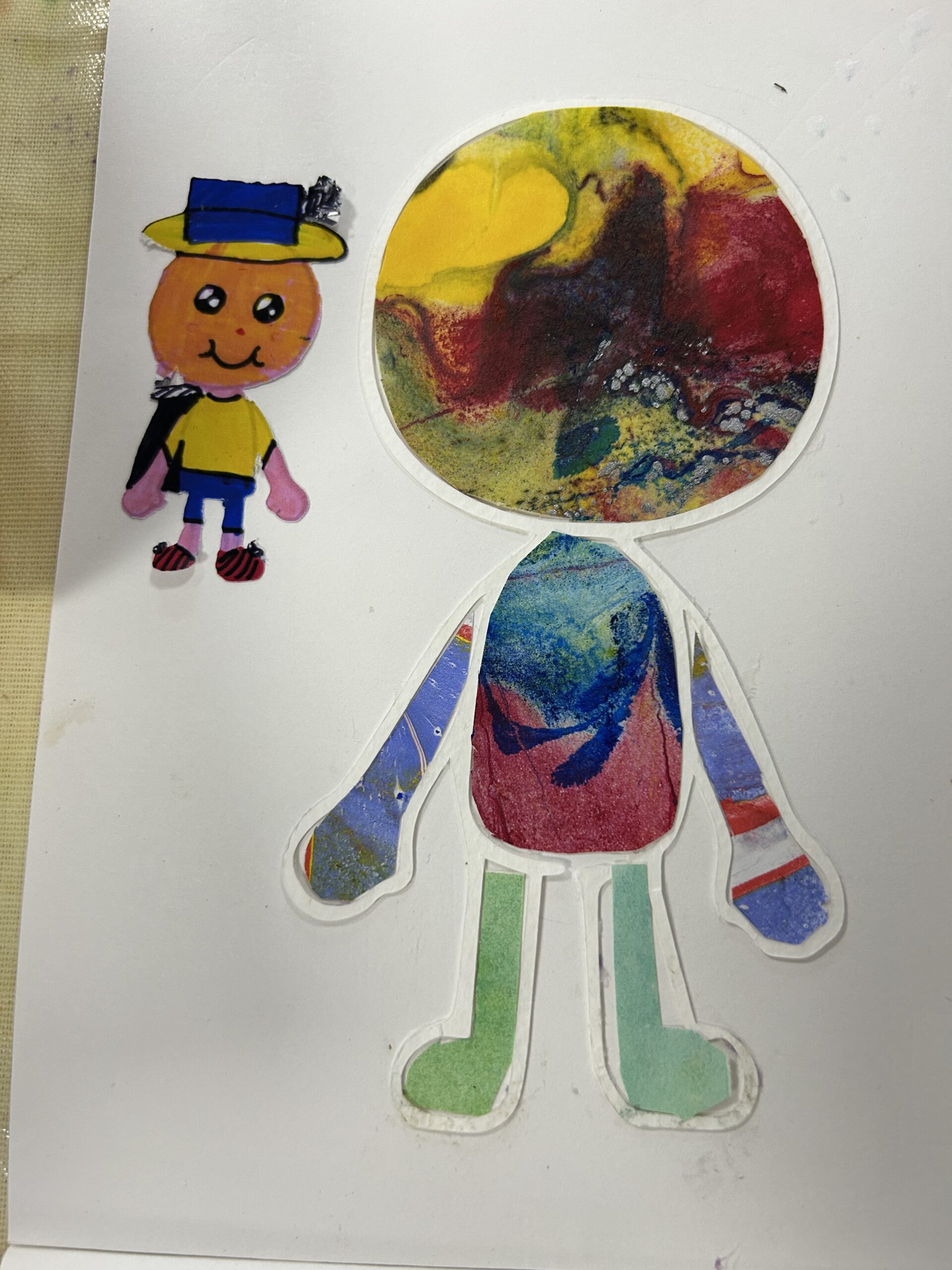
    The original aim was to use the humanoid outline to frame their pattern in one half, and then to create a collage ‘plate’ for them to cut out using the stencil as a sort of negative. But due to a combination of factors (including their dismay at using the purple glue sticks. NOT the purple glue sticks! They’re useless., most of the children decided to stencil directly on to their pattern, and then to cut the various scraps of marbled paper I’d provided into the frame of the body. In the end I think the pieces looked really fun – both their own versions, and the collages.

    I’ll definitely revisit this session/ method again, perhaps with different base shapes, perhaps looking more at masking and negative space. I might even let them loose on the watercolours again.

    Photo of stencil and collage man
    Collage on the left, stencil over pattern on the right.

    And while I like all of the spreads they produced, I have to confess a small soft spot for this one, as it used some of my personal favourites of the marbled papers I gave to them. The little chap on the left is this child’s character on the Island.

    Collage of a humanoid character using marbled papers.
    Imagined beings with marbled paper

    And I was also very pleased with this child’s work – the more attentive to the original brief, and more willing to embellish the end result. They’re getting a little more confident and expressive as they progress through the term.

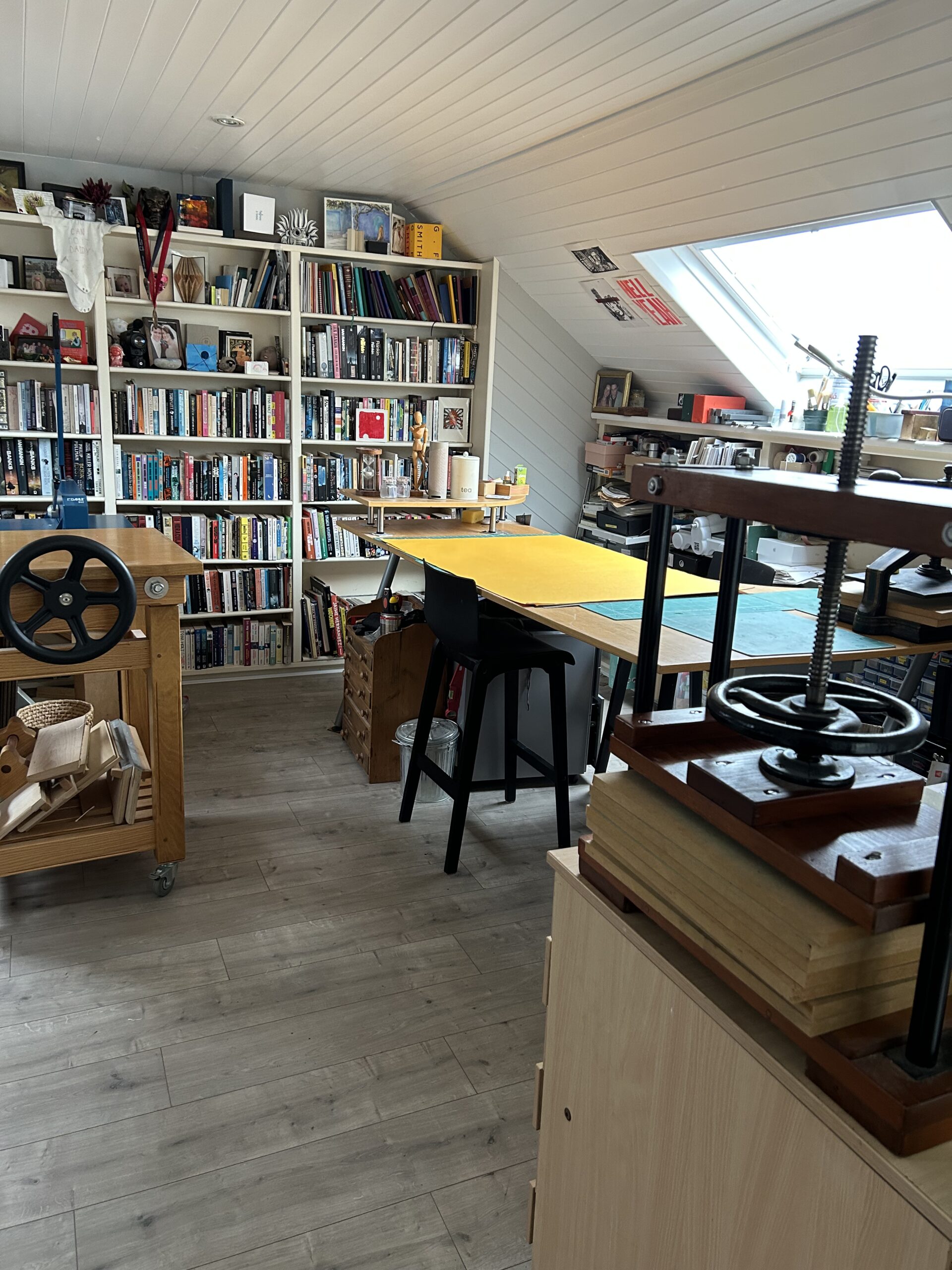
    Photo of a collaged figure
    Not clear if it’ whiskers or war paint, but isn’t this an expressive little folk?
  • Remastered/ Re-Arrangements in R Minor

    Remastered/ Re-Arrangements in R Minor

    Photograph of a studio bindery with presses, bench and other tools.
    Monk Quixote studio – bindery and craft space

    I was considering writing a blog post on starting again or new beginnings , but there’s been a few of those over the years, n’est-ce pas. So in the spirit of a post-punk age, I give you ‘Ivan-Remastered’ – all the hits you missed the first time around. Ok, maybe not ‘hits’. Maybe more 4AM 6Music R playlist. But more seriously, this time feels a little … different.

    First and foremost, I’m a little older and perhaps a little wiser. As most people learn over time, it’s easier to shuffle into change than to try to suddenly sprint in a new direction. Ease in, and learn to enjoy the process. This isn’t kind of like some big … I don’t know … melodramatic change driven by internal angst or mid-life crisis. It’s just simply that you get to a point with things where you need to say ‘enough’. Enough of that, and more of this. The specifics of the ‘that’ don’t really matter, but I’m trying to focus more on creative effort and less on creative product. This ties in more generally to an increased awareness of process, and simple pleasures in doing and being, rather than striving.

    The Re-arrangement

    I’m calling it a Re-arrangement. I like the capitalisation. Isn’t it grand? I like ‘R”s, almost as much as I like ‘K’s and ‘Q’s. I digress.

    Yes, I’ve been rearranging. The germ of this is a mental re-adjustment, triggered by a friend of mine who has introduced me to the field of awe studies. It turns out that awe is rather special, and a form of emotional resilience in the face of change. And we live in turbulent times, do we not? So triggering awe is a really useful thing to be able to do. Our individual triggers vary, although researchers have found various common themes. In working with my friend to develop tools and other things to help people understand and channel awe I’ve built a little game called SPARK!. And it’s in the spirit of this game that I have deliberately sought to fill more of my day with sparks, and less with the relentless enshittification of the internet. In my case, to re-awaken awe and channel positive things, I have arrived at a more conscious need for art – and specific kinds of art (more on this later).

    But sparks need space to thrive. So I’ve been re-arranging spaces – leaving digital spaces, reducing the activities that don’t bring me joy; changing my physical space; overwriting habits. I fear I would disgust my younger self, but I have even started experimenting with simply talking myself into doing things differently (e.g. ‘I am the kind of person who puts their shoes away’). Small things… after all, I am not committing to untying my shoelaces (yet). I’m not mad. But many small things can over time become a big thing.

    A space to make / making space

    I have spent the best part of two days moving the contents of my work and studio spaces around, which has involved decanting multiple cupboards, umpteen shelves of books, tools and materials, and arranging my space in more logical groupings. Echoes of a former self – my vinyl, graphic novels, science fiction and even some of my writing have been made visible and accessible again. I have culled 50-80 books, but still kept close to 400. Plenty of these books are unread, and never will be read. But I’ve always taken the view that my purchasing is part of the pay-it-forward part of life. I guess that’s a collector, rather than a reader.

    Anyway. As part of this re-arrangement, I’ve discovered treasures that I had long forgotten, and many ‘repeats’. I’m well aware of this particular trait of mine that I tend to have the same idea often. (The example that always comes to mind is the time I asked my then favourite author to dedicate a book , to discover I’d already dedicated it myself. The horror, the horror.) In physical terms it means I have enough adhesive to last me 10 years, and enough greybeard and book cloth to run a small press (now there’s an idea).

    At various points I seem to have been obsessed with having different specifications of the same thing. Which means three laying presses, three standing presses. Board in five thicknesses. Silk thread in colours I can’t pronounce. Enough waste paper to make a Daily Mail. As with many things to do with art and craft in particular, I seem to put a lot of stock in having tools and materials and manuals, and much less stock and in actually doing any of this. This is how I explain the manuals on writing sitcoms and spoon whittling. But I’m not sure it explains the Cambridge Illustrated History of Food or How to read a Church. Anyway, ’tis done now, and clearly the purchasing if not the filing and the using has made me somewhat happier at some point. We move on.

    Assembling boxes

    I found something this week which amused me… the concept of an artists’ assembling box, and that is very close to my idea for a story box, which is also very close, to be fair, to the idea that people at craft shows will sell you a collage kit which is full of old scraps and materials that that you then make into something else. Whereas my story box idea has some kind of guiding conceit behind it, some kind of narrative bone structure that you could use if you wanted to, whereas arrangement boxes, arranging boxes, sorry, I found them published by a Irish press seem to commission different artists to create one off. Well, unlike mine, these boxes are then collected and end up in libraries and museums and whatever, which is quite odd, considering that it’s probably not a very representative sample of any particular artist’s work, I’d have thought. But anyway, there it is. In the meantime I’ll plough on with devising my next story box….

    Remastered

    The other form of arranging that I’ve been very much into this week is compositions inspired by Northern industrial landscapes. To quote one of the artists ‘ Halfremembered journeys across post-industrial Yorkshire.

    This describes one of the two bands that are entering my orbit because they are supporting to Mogwai at various points this year. The first one is Forest Swords, who I now seen live in Cambridge. And that was extraordinary. A really, really impressive, and awesome, as in, it left an impression of awe in me performance by Matthew Barnes. It’ss just him and some electronics and a really, really interesting light show and this kind of weird, kind of loopy, lopey, I wouldn’t really call it dance music, but you kind of, you do, kind of, I don’t know you do, kind of bend and bob and nod, almost without control.

    The other artist, from which the quote comes is Craven Faults, and I knew nothing about him, and I put it on the speaker in the car when I was driving the other night. I drive an electric car which has a big tablet-like display, and it was nighttime, and the roads were largely empty, and modern cars, you have this kind of slight kind of cabin glow on the inside. The lights from cars tend to be kind of more horizontal and kind of strip, kind of LED type lights, rather than what you see in films of cars which is kind of very much kind of round tail lights and kind of kind of vertical kind of blur, if you see what I mean. Which is absurd in trying to describe any feeling as ‘horizontal’ rather than ‘vertical’. But it made sense at them time. And listening to Craven Faults (all 16 min bleepy bloop epics) and driving along in this car in the dark, it was amazing. I really felt like I was in the future. I felt I haven’t seen the Ryan Gosling film. I think it’s called Drive but there’s a very similar film – It may even have been the one that was based on, which I think Tom Hardy is in where all that happens is, or what mostly happens is a man driving alone in a car down motorways talking on the phone. Irrelevant detail, but you might want to watch it some day. I can tell I’m selling it.

    Anyway. It was a very profoundly moving experience, both literally and physically. This, ironically, is not awe. It is simply art. But, I it was quite something to be so aware of how alive I felt in that moment, and what it meant to be alive.

    Endinnings

    I’m rearranging my time as well, so I will continue to update this as I see fit and amuse myself. Even in writing this, I’ve actually enjoyed my own tangents. Which is just as well I used to worry a lot about having an audience while not having an audience. But it just doesn’t matter. The bit that matters is whether I enjoy what I’m doing or not.

    So I’m just going to quietly rearrange my thinking and hopefully see you soon.

    Love and rockets,

    I.

    Links:

    Frantichan’s Assembling boxes https://www.redfoxpress.com/ass.box.participants.html

    Craven Faults
    https://cravenfaults.com
    Listen to Ganger: https://youtu.be/P63rljfWrxU?si=vnyq_SFp9ubrE1Lo

    Forest Swords
    https://www.forestswords.co.uk
    Listen to Crow: https://youtu.be/lan-Pjv99Xk?si=kn1YSX9MlyFTOtFd

  • Story box(es)

    Story box(es)

    It’s been another long hiatus, for which I can only apologise to my solitary reader. I’ve been busy elsewhere but – as with many people – realising that the internet is not what it once was. So this is a little attempt at reclaiming a space, or if nothing else my copyright, of things online.

    This idea started a very long time ago, but for various reasons I never quite got around to making an edition until now. The idea of a story box is part game, part book, part mystery. It’s very loosely inspired by Rory’s Story Cubes and from stories-as-games I’ve developed with both my own children and the MQ Art Club.

    Story box elements ready for cutting, folding and sticking
    Story box contents ready for cutting, folding and sticking

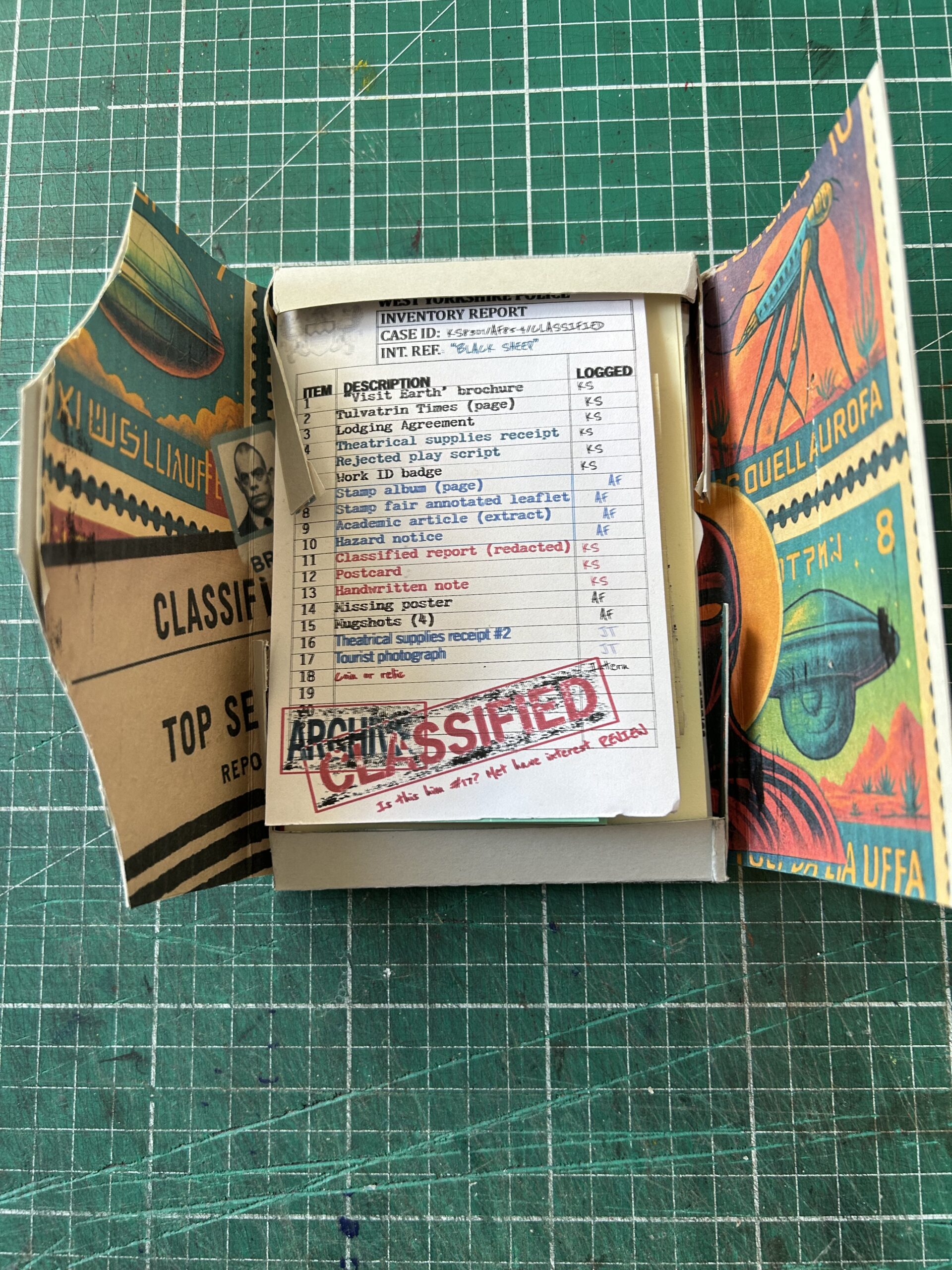
    This particular box – “Brøt – Operation Black Sheep” contains 23 different elements that when ‘read’ together form a narrative. And a ‘reading’ of the contents is included in the box, but this may spark more questions than answers. It also – I hope – makes it clear that there are other ways to tell the story, other ways to interpret the objects. And what I’d love is to hear from ‘readers’ what they make of it, how they interpret the story..

    Contents list
    Contents list / evidence file index

    This was tremendous fun to make, and includes something like ten different types of paper and card.

    Made in an edition of four, with three still available for sale. Purchase through the shop.

  • Onwards

    Onwards

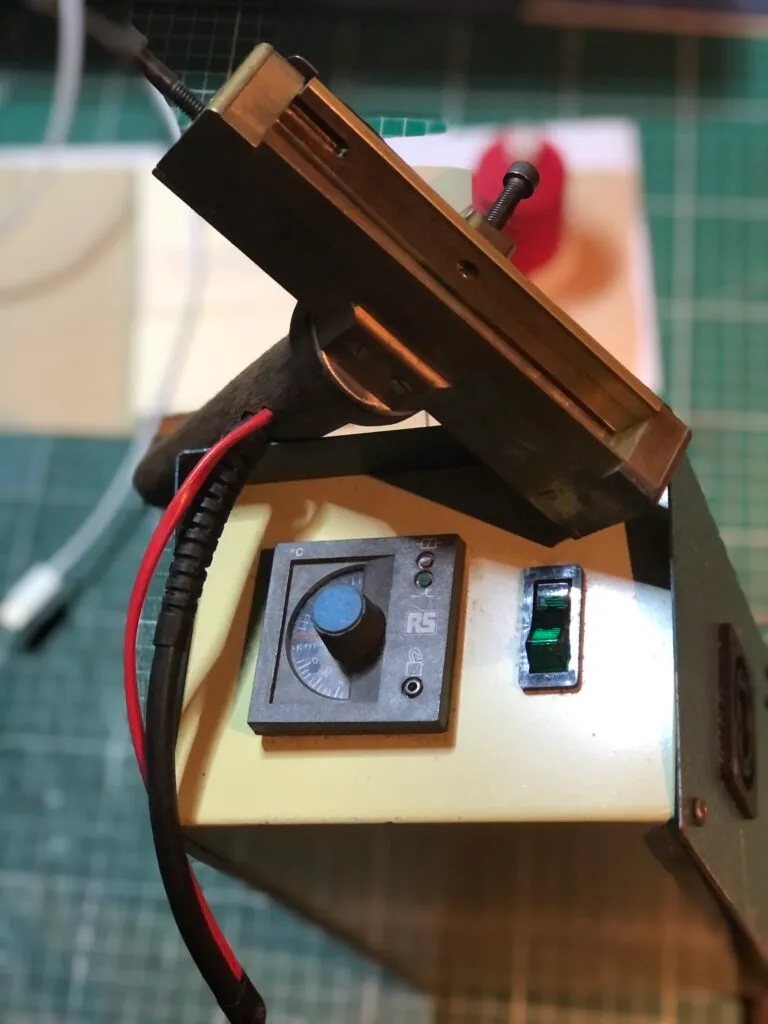
    Photograph of heated typeholder
    Electric heated type holder

    Gosh. Tempus fugit. The last few months have not been conducive to making art for a number of reasons, but I’m trying to remedy that in earnest now. I’ve been lucky to receive an unexpected windfall from an uncle who was instrumental in my childhood exploration of ideas and mediums.

    I remember vividly the ‘chinese’ painting set we explored in Granny’s living room. We painted Harlequin ducks from a small instruction leaflet, with the to-me revolutionary principle of loading a brush with two colours to create a blend/gradient. He was a talented artist – much better than I am – and particularly skilled with pencil drawing. If I’m not confusing my uncles he did memorable copies of da Vinci’s Vitrivian Man, and Dali’s Metamorphosis of Narcissus that lingers in the memory. So not shy of taking things on, and a little more ambitious than my ‘copy artists off Instagram’ style.

    I’ve added the funds he left me to the various tools, materials and ideas that I inherited from my mum. At the risk of becoming a collector rather than an artist I’ve added a few ‘nice-to-haves’ to my equipment list –

    • Cricut (the intention is to make stencils and possibly cut onlays directly from patterns);
    • heated typeholder (another absurd auction bid to complement the equally unused Marshall blocking press from the same source);
    • set of handle letters (York 30pt). The perennial challenge of attending SoB events in person is not walking away with empty wallet;
    • small brass cube from Arthur Green (see above);
    • set of Henry Taylor chisels;
    • a rather cute (and fortunately functional) miniature low-angle block plane;
    • a pair of sewing frames – I resisted for five years, which is a good effort.
    • (as part of a kit sent by Jeff Peachey) a large file, a rasp, scraper and a burnisher;
    • various Dremel bits and pieces.

    Basically other than the cube these purchases mean I’m exploring a bit more – historic book structures – particularly with wooden boards, and continuing to accumulate tools to improve my finishing options.

    As part of my continuing obsession with Ben Elbel’s structures I’ve also added to my paper stores – some interesting textured papers from GF Smith (including a fake leather which is really tactile); some gorgeous Hannemuhle for end papers, and a range of different Zerkall Ingres papers – possibly for print, more likely for endpapers. My plan chest drawers are now stuffed full. And I need to remember that…. make things! Use the materials!

    I’ve also taken a conscious decision to ‘go back to school’. While I enjoy Eduardo Tarrico’s and Susana Dominguez’ online courses, there’s nothing like live interaction with a tutor, and being able to ask questions while I’m making mistakes learning. To that end I took a couple of remote courses with US tutors last year – Karen Hanmer’s leather decoration course, plus Jeff Peachey’s toolmaking course – which worked up to a point. The latter was probably wasted on me – I simply didn’t have a firm enough idea as to what I would like to make tool-wise (other than ticking ‘do a Peachey course’ off my bookbinding bucket list).

    I’ve been struggling with time and motivation in most areas of my life – alongside working, and studying for a Masters, I’ve also become a UEFA C qualified coach (that sounds grand, it’s the lowest level grassroots football coaching qualification) and so the energy, patience and concentration to do ‘proper’ craft work is often lacking. But it’s good for me, and I enjoy it most of the time, so I’ve opted to return to try and do more ‘deliberate practice’ binding. So I’m spending the best part of three months doing one evening a week with Karen via Zoom (as part of her BiblioTech course examining the history of the book through various different structures), and in-person studio work with Mark (Cockram) at Studio 5 – the aim here is to get confident enough to enter competitions.

    This should mean that I have time on Tuesday evenings as I wait for the time difference to unwind to perhaps organise my thoughts and document a bit more progress. Not for anyone else’s benefit. For me. And in honour of those who are no longer with us.

  • I’m post or?

    I’ve had a number of opportunities to think about knowledge and the accumulation of expertise in the past week. Ignoring the highly VUCA world we live in (I love that expression ‘volatile, uncertain, complex and ambiguous’. I’ve described myself at various times professionally – and sometimes unprofessionally – as ‘a complexity vortex’. It’s very pleasing to know that there is a Harvard Business Review-approved term for it. And obviously that it is an acronym that you have to look up every time you use it because it’s easier to use VUCA as a throwaway term that will meet at least one condition in any particular environment), pretty much every area of my life. (And of course what I really want to do now is look up how to add footnotes to blocks in this editor, because in the unlikely event anyone reads this, then my poor reader is very quickly going to lose whatever thread I had to begin with. VUCA blogging.)

    Work has been challenging. I’m motivated by making things better – formally speaking that’s to improve capabilities through leveraging the work of others – be that ideas, models or tools. I spend a lot of time seeing people build triangular wheels. I dare say I’ve built my fair share too. But it’s extra hard at the moment. It’s hard when you see things others don’t – whether these are dragons, unicorns, or numbers. Anyway, not the time or the place.

    I’m studying for an MSc. This is largely to try and remove some lifelong scars from my undergraduate days. It shouldn’t really matter what badges you have, but for me, for now, it does – which is tedious as the impacts of studying are nearly all negative. Results so far are… mixed. The process is interesting, but the material is… well… academic. I’m used to explaining things, or writing proposals, or provocations. I’m used to critiquing the competition (or more often, ‘us’). I’m not used to thinking about what other people’s viewpoints would make of the same material. I’m used to applying that viewpoint, but not simply for the sake of doing it. Not very purposeful.

    I haven’t historically posted about anything other than fiction or poetry on this blog (if I’ve posted anything), but I’ve just joined an artist’s book group run by a keen member of the Society of Bookbinders and that was a schooling in itself. While I was showing some feeble attempts at non-traditional structures and wittering on about not having a voice, a couple of much more established artists talked in depth about their motivation, rationale, execution and response. I think I’m a bit better at appreciating experience nowadays but it was hard not to feel embarrassed.

    Which leads on to my latest adventure in impostor syndrome, as a team leader for a girls’ football team. One of the founding principles of this club is to resist coaching as much as possible and let the girls work things out for themselves. And it’s a fascinating process to watch and be part of – I mean it’s not as if they are not coached, but there’s none of the micro-management that I’m used to from my own football days (or indeed, that any armchair viewer/season ticket holder will feel entitled to do). And I think part of this philosophy is a much healthier approach to managing shame.

    There should be no shame in not knowing. There should only be shame in a lack of desire to learn, to grow. I fully agree with the club that we criticise effort not ability. Yet most of my life (this is a blog, it’s meant to be narcissistic) I have felt deep shame at getting things wrong, or more destructively – for the potential of getting something wrong. I’ve been known to leave a room when other people do something stupid on a television programme I’m watching. It’s a visceral reaction which I find very difficult to control. I guess Steve Peters would have something to say about my perception of self and the troop. But there are definitely aspects of my psyche that use shame as a stimulus – I wonder if that’s an instinctive thing or not. For example, I will make ‘better’ (or at least more conscious) art for the next meeting of the artists’ book group.

    It’s also ironic that I spend at least part of my professional life ’embarrassing’ myself. Taking chances. Being wrong. Learning, trying, failing. More often than not I’m actually ‘taking’ that shame for someone else. My job is to hand over once things are (more) certain – I remove or control some VUCA. But this is not a behaviour I’m used to applying in personal, artistic or social contexts. Is that simply competence? Or practice? Or necessity?

    Hmm. Been thinking about that last bit. I’m happy to be the clown, to volunteer when others don’t / won’t. I’m often deeply embarrassed about both types of behaviour. Again I guess it’s a chimp management thing – and it’s definitely an overthinking thing.

    Speaking of overthinking, it’s time to get on with the day, and put on my clown suit.

  • Meander

    I’m going to try and focus on deliberate practice as explained in Anderson’s Peak . I have been attempting to follow the audiobook of The Creative Habit by Twyla Tharp but I’m not getting much value from it.

    The winding road to reinvention

    I don’t really have a problem being creative, and if I’m honest with myself I can sustain productivity ‘when it matters’ – what I need to get better at is ‘when it matters less’ and also in being creative in a growth way.

    I continue to mess around at the foothills of creative skills development – having now amassed enough materials to run a small art shop, and enough instructional material to make my attempts at moderating my children’s consumption habits a total mockery. The challenge is not to constantly start again, but to push myself into new things.

    I guess the analogy is with running. You can run for various reasons – mental health, it helps you work through problems, physical sensation, as part of a wider programme, towards a set goal…. (and stretching the analogy arguably once you have a sufficient base level you can do more ambitious things without injury to body or pride). I do most of my art because it makes me happy. Now I need to work on my ability for art to make me feel good about myself – different concepts.

    I find the creative process soothing. Recently, while listening to one of my kids humming incessantly and the other singing while building LEGO (the ‘All I wanna do is poop’ song, an instant classic, highly recommended) – I recognised the trait in myself – when I’m happy I make ‘music’. Or more usually, I do something with one part of my brain – write, make – while listening to music. But sound is critical to my ‘process’.

    I’ve reflected a few times how the feeling of being ‘enclosed’ in my studio is part of my enjoyment. I prefer (or maybe I simply associate more) with working in the dark, listening to (mostly) obscure music on BBC 6 Music. The joy of working in the studio outside conventional office hours is basically the playlist is eclectic.

    Which is all a very long-winded way of saying that last night I made some endpapers for a couple of Bradel notebooks; cut enough millboard down to make a further five; and used the offcut from the Canson endpapers to begin making a modified Shrigley. And during the work I heard this, and was enchanted:

    Katherine Priddy is on tour with Richard Thompson in the UK at the moment (2021)

    Although to think I am reinventing myself as a folkie is probably a step too far. But what a beautiful voice.

  • Identifying as…

    Thog


    August 2021

    Time to refocus this blog on the activites I’m currently engaged in – linocut, bookbinding and occasional art. I’m hoping that in doing so I will reignite my writing mojo. But we shall see.

  • August 2021 Reflections – folding

    Accordions, onions, blizzards and other folding structures

    In the past few weeks I’ve been broadening my understanding of structures. Last year Ben Elbel ran a promotion through Designer Bookbinders which led to be buying two tutorials + materials – I had a really tough time choosing but in the end went for an aesthetic (Onion) and an introduction to (sewn) albums (Shrigley).

    Shrigley binding
    Shrigley binding housing photos of my favourite linocut print

    On the Shrigley I had a few issues with the accordion – this was a poor choice of mine to start with the kit rather than waste materials. I also don’t quite understand the back board connection – it doesn’t look as elegant as the rest of the structure.

    The squash triangle fold (as I now know it’s name) is particularly useful as it holds material really simply and all you need is to have a border around your page. Like having inbuilt photo mounts – I will try and incorporate this feature into a ‘normal’ section soon, see how that plays out. I guess it would add a bit of bulk so you’re not going to want to overdo it.

    Photo of Onion binding
    Onion binding using scrap materials

    The Onion binding was more successful even though the folds are much smaller. This time I did use spare materials, although this was also a minor challenge as the heavier weight paper (230gsm) I bought from a Wayzgoose doesn’t take folds well (it crumples) and the green ‘lighter’ paper (also Wayzgoose, it’s thinner but stiffer than the white) is possibly more dense. It’s a relatively easy structure to do ‘ok’ and a really hard structure to make it look really sharp.

    Both structures use only paper and cardstock, so this also gave me an excuse to buy some more exotic papers from G F Smith. I’m particularly looking forward to using their leather effect heavier papers.

    Having started at the more difficult end, I then decided to begin working through Hedi Kyle’s Art of the Fold as some of Bookbindingoutofthebox structures have their origins there. So far these are all maquettes using cartridge paper and other bits of scrap.

    Photo of accordion paper structures
    Top left is a simple accordion with pocket. Top right is accordion with jacket, bottom is accordion with ‘school’ cover.

    These accordion structures are addictive and simple to make. Other than a couple of measurements these are also simple enough to do with the children, and C has been busy making several versions of the accordion for her new teacher, friends etc., It always makes me very happy when they get enthused by any form of bookbinding or paper craft. We did end up making an interlocking flag book, but I prefer the ‘pocket’ structures.

    The header image shows the blizzard structure I then mocked up using GF Smith Everyday 100 gsm and some imitation parchment paper. I printed an old map of Richmond on the accordion (love the way the Epson can print oversize lengths) and cut up photos of some doctored vintage postcards of my local area. A bit crude in execution but enough to give me ideas….

  • Documentary and inventories

    A couple of displacement activities this week – new arrivals in the paper department (from GF Smith) and collating all my linocut blocks and remaining prints of the last 18 months. This led to a rather pleasing reminder that I’ve created quite a few prints, and that in turn led me to look at the shelves and try and assess the number of different binding (styles) I’ve done.

    • Pamphlet binding
    • Flatback multi-section
    • Multi-section case
    • Bradel
    • Disappearing spine Bradel (Cockram)
    • Library style (English)
    • Library style (Tarrico)
    • Jean de Gonet (Tarrico)
    • Crown / Star (Kyle)
    • Drum
    • Longstitch
    • Japanese (variation)
    • Crisscross / Belgian
    • Shrigley (Elbel)
    • Onion (Elbel)

    Which was another pleasant surprise, although I think I’m only competent at perhaps three of these (and some I’ve only done once).

    The point really is that I haven’t been doing a great job of documenting my progress in any formal sense, and perhaps posting will encourage me to be a bit more ‘formal’ about it. We shall see.

  • From the studio…

    From the studio…

    A selection of photographs of some of my recent work or new things to have arrived in the studio/bindery.