
This week’s MQ Art Club was one of my favourite sessions with this particular group. I’ll describe what I did later on in the blog post, but as I’m in the process of working out what went well and what went less well I’lll write a bit about the general process to begin with.
Underestimating and overestimating
This group are younger than previous groups I’ve run, and I’ve faced a few challenges:
- Are the children capable of the tasks I have prepared? This is as much about social skills as it is about their actual skill with a Sharpie or a paintbrush.
- Are the children interested in the tasks I have prepared? I spent a considerable amount of time and effort this term in preparing an over-arching narrative for the sessions – a ‘season arc’ if you will, and this hasn’t landed in the way I’d hoped. This partly relates to the previous point about capabilities – the degree of role-playing and world building with relative strangers has been a constant challenge.
- Do I have the skills to wrangle this particular group? The mix of age groups is not really the issue, as the different year groups largely ignore each other. But what is a definite issue is that I took for granted that I could ‘manage’ a group of 8 year-olds. And while there are some ‘typical’ behaviours, they are very much individuals, with individual needs and interests, even if only for 90 minutes a week. My admiration for school teachers goes up week by week. I have it relatively easy – a small group for 90 minutes once a week.
Arguably however, the biggest challenge has been my inexperience. For the vast majority of the sessions I have simply never delivered that specific session before, let alone that session in that context. In particular, the context of boredom, or rudeness, or kids simply having had enough of being told what to do on that particular day – one particularly difficult session I only realised as we were packing up that they hadn’t left the building all day as it had rained all day. I needed a physical component that day.
On plans surviving contact with the enemy children
I enjoy making the session plans, and while the kids may not always realise or appreciate the effort, I have usually spent hours researching and planning any given session. What this research, and reading around, and even occasionally simply copying other teaching resources can’t prepare you for is the group context. It’s a natural tendency I think to explain too much (verbally) and focus on details that they simply don’t care about.
This was much less of an issue when the sessions were about collaborative art on a shared canvas – sessions could be much looser and dynamic. But partly because they would go off-script themselves, and partly because this particular set of individuals aren’t equally confident in sharing ideas orally, I abandoned the shared canvas in favour of the shared story / season arc. The unforeseen consequence of switching to more of a ‘product’ approach is that without very clear models/references, some of the group take a very long time to activate. And the provision of references in themselves creates a tension for the more creative folk who then essentially look to ‘take me on’ – either by ignoring the brief or disrupting others. So in general it often feels very disjointed, with the emphasis much more on individual performance, which in principle was what I was hoping to avoid.
But – first and foremost this is kids-first, so it’s largely a matter of amplifying some aspects and then encouraging the process and effort whenever possible. I think I’m getting a little better at this. I don’t have as much control as my ego wants, and I miss the elaborate group stories, but the children are – I think – a little more engaged than they were. And it’s more fun for everyone as a result.
On to this week’s session….
An assortment of oddments and odd minds

The session itself was to take place in Patchwork Hospital on Mystery Island. (I’ll write more about Mystery Island another time) The narrative setup was that their characters had been given something to drink that had brought them out in … patches. And they were to create pictures of what that looked like. Although of course this is my post-session rationalisation of what I thought I told them, whereas by withholding the idea of the stencils and the templates until the second half some struggled to engage with the notion of ‘patchwork’ or ‘fill the space with patterns’.
I was particularly pleased with this week’s outcomes, and these also emerged as the children made decisions and discoveries independently. I asked the children to split a page in half, and to add patterns to one half of their own choosing, There was an interesting little observation here in that all bar one of the children started their patterns at the top left, with only one going for a more free-from, less structured pattern. The actual generation of patterns was a lot more time consuming than I’d anticipated, and this I put down to not producing a reference for them – I am a little too obsessed with them generating their own ideas sometimes. So that would be something to change for next time.
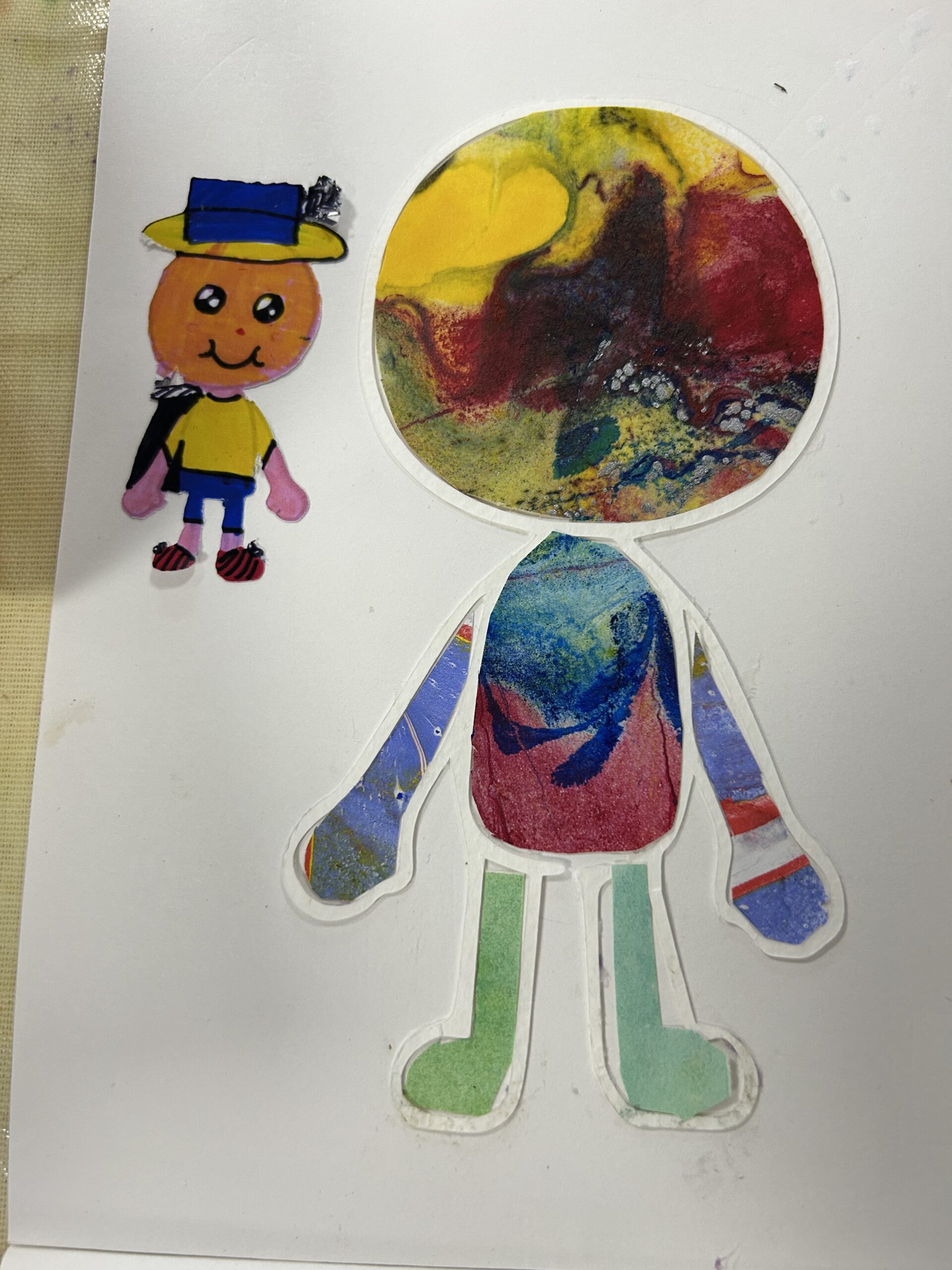
The original aim was to use the humanoid outline to frame their pattern in one half, and then to create a collage ‘plate’ for them to cut out using the stencil as a sort of negative. But due to a combination of factors (including their dismay at using the purple glue sticks. NOT the purple glue sticks! They’re useless., most of the children decided to stencil directly on to their pattern, and then to cut the various scraps of marbled paper I’d provided into the frame of the body. In the end I think the pieces looked really fun – both their own versions, and the collages.
I’ll definitely revisit this session/ method again, perhaps with different base shapes, perhaps looking more at masking and negative space. I might even let them loose on the watercolours again.

And while I like all of the spreads they produced, I have to confess a small soft spot for this one, as it used some of my personal favourites of the marbled papers I gave to them. The little chap on the left is this child’s character on the Island.

And I was also very pleased with this child’s work – the more attentive to the original brief, and more willing to embellish the end result. They’re getting a little more confident and expressive as they progress through the term.

Leave a Reply